In response to the experience of teachers piloting the course, we’ve revised CIR's opening.  Learners were resisting the investigations primarily because they were unlike the "read and remember game" they'd come to expect to play in school.

Mindy Nathan, principal of an alternative school in Bloomfield, Michigan, wrote to us:

"...My kids LIKE and PREFER the surface requests of conventional test questions that don't demand thought. It's like a relief to them. Crossing the barrier – the chasm that exists in their preference for ease and rote response, and the deeper, meatier, cognitive processes – is a gigantic
challenge...I am dealing with kids at the end of their frustration level, who have never experienced (or haven't recognized?) true joy in learning."

Two new introductory activities titled "Thinking about Thinking" have been added to address the problem. The activities point out to students that they constantly engage in "higher order" thought processes, and that doing so isn't more difficult than memory work, just different, and far more useful.

Introduction: Thinking About Thinking

In response to the experience of teachers piloting the course, we’ve revised CIR's opening. Learners were resisting the investigations primarily because they were unlike the "read and remember game" they'd come to expect to play in school.

Mindy Nathan, principal of an alternative school in Bloomfield, Michigan, wrote to us:

"...My kids LIKE and PREFER the surface requests of conventional test questions that don't demand thought. It's like a relief to them. Crossing the barrier – the chasm that exists in their preference for ease and rote response, and the deeper, meatier, cognitive processes – is a gigantic challenge...I am dealing with kids at the end of their frustration level, who have never experienced (or haven't recognized?) true joy in learning."

Two new introductory activities titled "Thinking about Thinking" have been added to address the problem. The activities point out to students that they constantly engage in "higher order" thought processes, and that doing so isn't more difficult than memory work, just different, and far more useful.

Investigation: Thinking in School

Investigation: Thinking in School

Investigation: Mental Puzzles

Some comments on the second ("Thought Processes") part of the first Investigation:

1. Draw a map of the area where you live.  (Probable thinking processes: remembering, translating; perhaps "observing" should be added.)

2. Discuss which is better: great clothes, or a cellphone. (Valuing)

3. In the area where you live, from what direction do winds usually blow when storms approach? (Remembering, generalizing, perhaps application of principles and hypothesizing)

4. Many different kinds of vehicles are used to transport people. Make a list. (Remembering, concept-application)

5. Based on your experience, describe the different ways people react to very bad news. (Remembering, generalizing)

Note that so long as students are really "thinking about thinking," there are no wrong answers.

About This Program

I’ve been in education since 1932 as student, teacher, administrator, textbook and professional book author, publisher consultant, teacher educator, contributor to professional journals, newspaper columnist, and visitor to schools as far east as Greece and as far west as Japan. I have opinions that helped shape Connections: Investigating Reality:

On the challenge – Forget rocket science and brain surgery. Compared to educating–helping learners better align their mental models of reality with reality–both are relatively easy. Educating is inherently the most complex of all undertakings.

Aim – The main aim of educating is simple, and every learner needs to know exactly what it is–some version of, "making more sense of experience by understanding the sense-making process."

"Covering the content" – Forget this too. It hasn’t been possible since the Enlightenment, and the assumption that it should be done (or at least attempted) is naive and destructive. It’s best to see it for what it is–dynamic, constantly changing, never equally appropriate for all students, and with the possible exception of a tiny fraction of it, not worth storing in memory. Choose from it what helps explain and elaborate the sense-making process. That process is the main content.

Textbooks – My brother and I have written two for Prentice-Hall, but I consider them a major obstacle to learning. If educators demanded that they be no more than, say, fifty pages long, improvement in the quality of American education would be almost instantaneous.

Pacing – The whole idea of a "pacing guide" is ridiculous, a futile attempt to standardize the unstandardizable. If you’re trying to help learners understand something really important, there’s no point in moving on to a second idea until they understand the first, even if that takes days, weeks, months. CIR tries to lay out the whole of the "liberal education" ball of wax, so don’t rush it. Take as long as it takes.

Teacher Role – The longer I taught, the less I said to students. I came to see myself as a co-learner and behaved accordingly, mostly just asking questions, always looking for ones so thought-provoking I could just wander around from group to group and say nothing at all, just listen and learn.

Class Organization – Writing CIR, my brother and I assumed that most of the work would be done in small groups. Learners learn a lot by "thinking out loud," and small groups maximize opportunities to do that. At the end of an activity, it’s often useful to let the groups "have at it" with each other, or pool their insights and conclusions.

Target AudienceCIR was written with adolescents to adults in mind, so the language is simple even when the ideas aren’t. Because it focuses mostly on the real world and user experience of it, it automatically "adjusts" to different ability levels.

"Standards" – The usual subject-matter standards that No Child Left Behind forced states to adopt are suicide pills, reinforcing the worst aspects of traditional education–-that the point of it is to "cover the material," that fragmenting knowledge is OK, that innovation and change aren’t necessary. If higher authority says they have to be honored, know that there’s no legitimate standard that CIR can’t accommodate, that it’s just a matter of fitting it in where it makes the most sense.

"Accountability" – When you’re making judgments about complex performance, there’s no avoiding subjectivity (which is one of many good reasons for team teaching). Standardized tests devalue the very qualities and abilities most essential to individual and collective survival.

AcceptanceCIR will be rejected for mainstream use as long as the present thrust of "reform" (doing what we’ve always done, only longer and harder) continues. The most likely users are those working with learners either so far advanced or so far behind, their scores on standardized tests are of little concern.

Implementation: We think that, in about two hours a day, CIR can do a better job of realizing the aims of a traditional liberal education than is now being done in five or six hours, and that the rest of the day should be used for doing what we say we think is of supreme importance but don’t actually do–help individual learners identify and pursue their interests and maximize their talents and abilities. Magnet school administrators should be particularly interested in instruction that decreases time spent on general study.

Marion

Connections: Investigating Reality - A Course of Study

Investigating Systems - Introduction

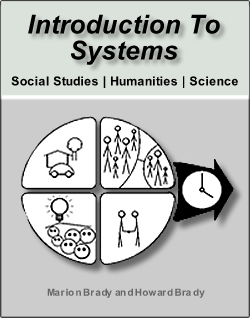
Connections: Investigating Reality is a free course of study designed primarily for adolescents and older students, working in small, cooperative groups. It's downloadable from this page.

The program's overarching aim is expanding learner ability to "make sense" of reality, an aim we consider essential to the achievement of all other legitimate aims of a general education.

The activities in Connections rely heavily on ordinary, first-hand user experience, require the use of all thought processes, progress slowly through increasing levels of conceptual (as distinct from textual) complexity, and, as is true in all attempts to make sense of experience, move constantly across and beyond arbitrary disciplinary boundaries.

Its final "product" is meant to be a comprehensive, seamless, systemically integrated, permanent, "master mental model of reality"--a kind of template which, superimposed on real-world experience, routinely translates information into knowledge, and knowledge into wisdom.

Note: This, "bottom up" approach to curriculum reform is obviously an unusual undertaking, one that can profit from extensive, on-going dialog. If you like what you see and decide to use it, your participation in an interactive, supportive, on-line community to explore improvements, discuss learner reactions, and offer additional or alternative activities, is invited.

To facilitate dialog, the column on the right on this page provides links to pages for general discussion of the program, and for discussion of individual activities.

Download Investigating Systems
Complete this form to download
"Connections:
Investigating Reality
"
First Name
Last Name
Role
Address
City
State
Zip
Phone
Email

If you have any problems using the form please email your information to
Howard Brady / Marion Brady.

PRIVACY NOTICE - All personal information will be stored, but not publicly displayed or made available without your consent. Your information will not be transmitted or shared with any third parties without your express written consent.


Marion BradyHoward Brady

Big ideas that shaped Connections:

  • The future will be more complicated than the present. Old solutions won’t solve new problems.
  • To solve problems, you need to make sense of the real world.
  • In the real world, everything connects. You’ll need to understand “systems.”
  • Because they’re the creators of all sciences and all arts, human societies are the most important systems you can study.
  • Making sense of systems requires organized thought. School subjects aren’t very good organizers.
  • Thinking about ways to organize thought improves how you do it.
  • For sense-making purposes, the real, everyday world is a better “textbook” than textbooks about it.
  • Everything you learn should be useful, right here, right now.
  • Writing makes you think. (Keep a journal.)
  • Dialog makes you think. (Work with others.)
  • We’re not going to tell you much. We’re just going to give you a series of things to do and let you teach yourself how to make more sense of systems.


Marion BradyHoward Brady

PART 1: Linking Information

Investigation: What’s Going On Here?

Investigation: Categorizing Information

Investigating Patterns

Active-Mode Learning

In traditional classes, the student’s role is to “absorb” information from text and teacher. In this passive mode, maintaining student interest is a never-ending challenge, students have difficulty retaining what they’ve learned, and complex student thought processes are largely neglected.

Common sense says that life requires the constant use of many complex mental processes. Spending vast amounts of time on just one—recalling —is a poor use of that time.

Challenging students intellectually, requiring them to take an active role in finding answers to important questions, has proven over and over to be the most effective way of teaching and learning. Student motivation increases, that which is learned is less superficial, less likely to fade from memory, and the skills acquired in the process of learning enhance the student’s life-long ability to make sense of experience.

The main components of this book, “Investigations,” provide instructions and raw materials for activities illustrating active-mode learning (and much more).

When students are solving puzzles rather than dealing with conventional narrative, intellectual surprises result. What has traditionally had the highest payoff at grade time are symbol manipulation skills and a good memory. When students are presented with work that demands the use of a full range of thought processes, class rankings and perceptions of self often change.

Labels:

Investigation: Social Patterns

Investigation: Biological Patterns

Investigation: Mathematical Patterns

Note that series near the bottom are quite difficult.
Answers:
a) Each number increases by 3 over previous
1, 4, 7, 10, 13, 16, 19, 22

b) Each number increases by 8 over previous
5, 13, 21, 29, 37, 45, 53, 61

c) Each number increases by 4 over previous
11, 15, 19, 23, 27, 31, 35, 39

d) Each number increases by 7 over previous
3, 10, 17, 24, 31, 38, 45, 52

e) Each number increases by 9 over previous
5, 14, 23, 32, 41, 50, 59, 68

f) Each number increases by 2 over previous
6, 8, 10, 12, 14, 16, 18, 20

g) Two successive integers, skip one integer, two successive integers, etc.
1, 2, 4, 5, 7, 8, 10, 11

h) Up 6, back 3, up 6, back 3, etc.
3, 9, 6, 12, 9, 15, 12, 18

i) Binary series. Each number doubles previous.
1, 2, 4, 8, 16, 32, 64, 128

j) Interval between numbers increases by one for each step.
1, 2, 4, 7, 11, 16, 22, 29

k) Alternate numbers increase by 11, which increments both digits. In-between numbers reverse the digits of the previous number, and they also increase by 11. The series only works for two-digit numbers.
51, 15, 62, 26, 73, 37, 84, 48

l) Fibonacci series. Each number (after the first two) is the sum of the two previous. The Fibonacci series describes the spiral growth in seashells and other geometric growth in nature.
0, 1, 1, 2, 3, 5, 8, 13
(The next numbers: 21, 34, 55…)

m) Factorial series. Each number is the product of successive integers. For example, the fourth number is 4! (4 factorial) = 4 x 3 x 2 x 1 = 24,
the fifth is 5! = 5 x 4 x 3 x 2 x 1 = 120, etc.
1, 2, 6, 24, 120, 720, 5040, 40320

Labels:

Investigation: Literary Patterns

Investigation: Target Area

Investigation: Patterns in the Target Area

Investigating Relationships

Investigation: A First Look at Relationships

Investigation: Aerodynamic Relationships

Investigation: Geographic Relationships

Investigation: Relationships in Public Issues

Investigation: Physiological Relationships

Investigation: Relationships in the Target Area

I. Branching Out (1)

I. Branching Out (2)

Analytical Categories

Investigation: Developing Analytical Categories

Investigation: Insect Analysis

Investigation: Analytical Categories in Commerce

Investigation: Analytical Categories in the Target Area

I. Branching Out

PART 2: Analyzing Systems

Investigation: Building and Analyzing a System

Thus far we have no substantive changes in the IS curriculum. The kids are having great fun with the "systems" part of it right now. The challenge was to make some sort of toy using cast off materials (read "trash") from home. Thus far we have seen a blow gun, a color wheel illustrating chromatography, a trebuchet, and, of course, the irrepressible battery. The kids work in groups then present their toy to the class and answer questions about the systemic nature of the toy. My favorite part is the Q & A. The kids ask some really insightful questions. They are definitely becoming "systems" thinkers. Bill

Labels:

Investigation: Looking at Other Systems

Investigation: Target Area Systems

Investigation: Ecology

Systems With Human Components

Investigation: A System Involving A Human

Investigation: Systems With Several Humans

Investigation: People/Demography

Investigation: Patterns of Action

The Whole Model

Investigation: Target Area Systems That Include Humans

Investigation: How Universal Is Our Human Systems Model?

PART 3: Major Human Systems: Societies

Investigation: Traditional Korean Society

Investigation: Colonial Virginia Society

Investigation: Native American Societies

Investigation: Traditional Afghani Society

Investigation: Comparing Societies

Investigation: Societies In The Target Area

Investigation: Identifying Sub-Categories

Investigation: Identifying Category Problems

Investigation: Sub-Societies in Your Area

Investigation: Extending the Model

PART 4: Investigations of People/Demography

Investigation: Locating Societies

Investigation: Demographics/Population Pyramids

Investigation: Target Area Demographic Change

Investigation: Extended Life Spans

IV: Branching Out (1)

IV: Branching Out (2)

PART 5: Investigations of Environment

Technology as a Part of Environment

Investigation: Stirrups and the Rise of Feudalism

Investigation: City Design and Behavior

Investigation: Apartment Environment and Crime

Investigation: Modifying Your Environment

Investigation: Target Area Environment

PART 6: Investigations of Patterns of Action

Investigation: Patterns of Conversation

Investigation: Significant Patterns in Your Target Area

Investigation: Historical Changes in Manufacturing Patterns

Investigation: Patterns of Mobility

Investigation: Marriage Age Patterns

VI. Branching Out

PART 7: Investigations of Shared Ideas

Investigation: Actions Growing Out of Beliefs

Investigation: Puritan Beliefs

Investigation: Immigrant Ideas

Investigation: Native Americans and English Colonists

Investigation: Individual Feelings and the Model

Investigation: Summarizing Ideas of People in Your Target Area

PART 8: The Dynamics of Change

Investigation: Flow-Charting Change

Investigation: Complex Causation

Investigation: Feedback

Investigation: Analyzing Multiple and Cumulative Causation

Investigation: Identifying Cumulative Causal Sequences

Investigation: Negative Feedback

Investigation: Target Area System Change

PART 9: Change and Stress

Investigation: Action Pattern Stability

Investigation: Shared-Idea Stability

Investigation: Change-Triggered Conflicts

Investigation: Target Area Conflicts

Investigation: Incremental Change

Investigation: Monitoring Change

Investigation: Predicting Future Change